"Progress comes from adapting"
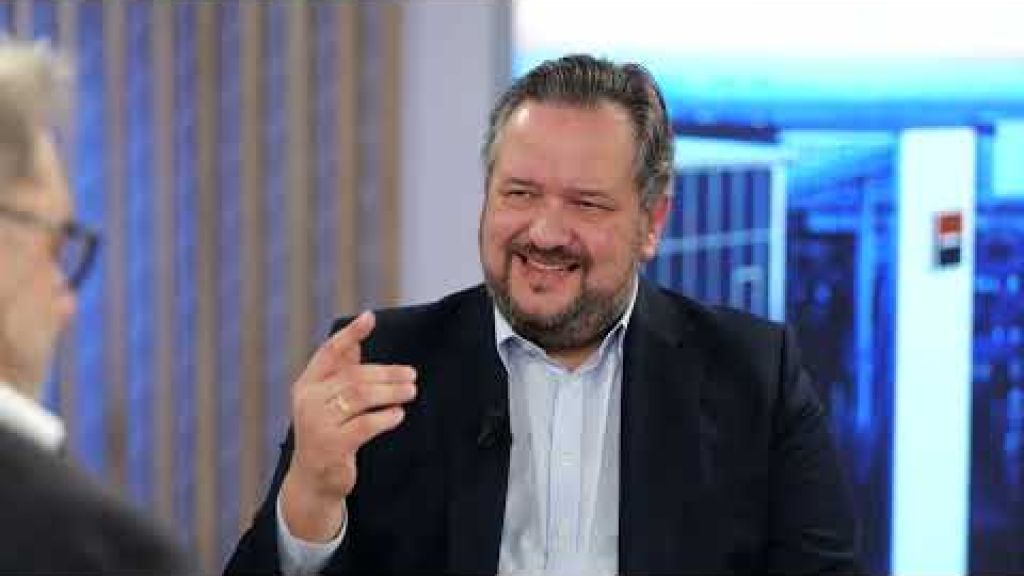
CEO Dialogue, an exclusive interview with Slawomir Krupa for IMD Business School.
Slawomir Krupa’s vision
In this conversation with Jean-François Manzoni, Professor of Leadership and Organizational Development at IMD, Slawomir Krupa, CEO of Societe Generale, shares his vision of leadership and responsibility at the helm of a Group with more than 160 years of history. He discusses acting with high standards, transparency, and a long-term perspective to leave future generations a stronger company.
Engage, decide, and act in the company’s best interests
Throughout the interview, Slawomir Krupa candidly addresses the challenges shaping the Group’s evolution: strengthening the foundations, accelerating growth, making bold strategic choices, and reinventing work processes. He reiterates his strong belief that leadership is measured by one’s ability to engage, decide, and act in the company’s best interests every single day.
Jean-François Manzoni
I'm delighted to speak today with Slawomir Krupa, CEO of Societe Generale. Societe Generale is one of Europe's leading banking and financial services groups created in 1864. So 161 years old, 119,000 employees, 62 countries, 26 million clients generating. And these are the 2024 numbers, around 27 billion euro revenues and over 4 billion euro net profits. Market capitalization these days at about 55 billion euros. But it wasn't always like this. When Slawomir Krupa took over as CEO in May 2023, the bank's stock price was even lower than it had been 15 years before coming out of the GFC. There had been ups, there had been downs, but overall, Societe Generale had largely lost favor with investors and was trading at a very significant discount to its major competitors.
Under Slawomir's leadership, profits have increased significantly and the stock price has more than tripled, including a spectacular year in 2025 during which the Societe Generale stock was the best performer in the French CAC 40 index. Slawomir Krupa was selected as the next CEO in October 2022 and took office officially, as I said, in May 2023. Prior to becoming CEO, he had worked almost his entire career at Societe Generale, starting with eight years at Inspection Générale followed by increasing responsibilities in the corporate and investment banking division, leading him to become CEO of Societe Generale Americas and leader of the Global Banking and Investor Solutions business. Slawomir, thank you for making time for us and also for having me today in your head office building.
Slawomir Krupa
Thanks for coming and I'm delighted to have the conversation with you. Thank you very much.
Jean-François Manzoni
Slawomir, let me start by going back to when you took over as CEO. You had an eight-month period of transition, which is relatively long by corporate standards, and then in September 2023, you announced your new strategy with two major pillars, rebuilding the bank's capital and reducing costs. Please tell us more.
Slawomir Krupa
I mean, there are many, many ways of saying the story, of telling the story, of talking about that. The one I usually prefer to choose in terms of analogy, image, whatever, is this idea that we inherited, at that point in time, a house, a house that had been around for 160 years, serving again, customers with a lot of storied achievements throughout the years, but which at that point in time, had weak foundations. And no company, no human endeavor really, but no company can thrive with weak foundations. And I would argue that a bank even less than any other company. And so really, this was my assessment, arguably different from the previous management, and I decided that we needed to focus first and foremost on that, raising the capital, which meant, so you say we go from 12 to 13 CET1 ratio, you think it's nothing.
Well, it's 4 to 5 billion euros of capital increase that instead of doing it by raising it with investors and diluting the hell out of the ones who stayed with you throughout all these difficult years in terms of valuation in particular, we chose to do it internally by saving the capital in terms of organic investments of capital into our businesses on the one hand, and then on streamlining our businesses and going through a program of disposals. Eventually, we managed to raise that capital base and fix the foundations without going, resorting to diluting shareholders, which I think was a fundamental challenge and which we chose to face, we chose to handle, and we're happy about that and delivered upon.
Jean-François Manzoni
So I'll come back on the reduction of the cost base in a second, but I want to ask a follow-up question on these disposals, of course, exposed from the outside, it always looks simple, but the reality is a number of the organizations that you disposed of were subsidiaries, for example, in Africa, and I remember that there was some press that raised questions about it, I'm sure that internally, there were people who were profoundly attached to these. So tell us about, I guess, the resolve or the drive that it takes to make decisions that essentially go against decades of operation.
Slawomir Krupa
Listen, in my view, it's the job of a CEO and the board of course, in terms of validating the CEO proposal if they so decide. But it's our job. It's at the heart of what we have to do of we owe to the company that we're leading, that I'm leading, is to make decisions, right? To come up with a strategy, implement it with resolve, as you said, and just remain guided by what's the interest, the superior interest, so to speak, of the entire company long term. And I actually say this often to my teammates and to the leaders of the organization, when in doubt, ask yourself what's the best for the long-term success and sustainability of the company. And then, 9 times out of 10, the answer is very easy. So coming back to your point, yes, it was difficult. You said it, one of the subsidiaries we disposed of in Morocco was with the group for over 100 years.
So believe me, we didn't take this decision lightly. I didn't take it lightly, but this was without a doubt the right decision for the group, not only today, but in the long term. And the other thing is we also, and I said it publicly, I made it a criterion of how we're going to execute this, is that we would do it in a responsible way. So not selling these assets at stupid prices, not selling them too fast, not selling them to the wrong people, but making sure that these people who had been part of our story and these entities, again, sometimes for 100 years, that they had the right future. And arguably, I do believe so, in most cases, a better future with better shareholders for them at this point in time. So this is what we're trying to do. And so guided by these principles, you just stick with the decision and the facts, and the facts. Why we sold each business was factual, rational process, never driven by emotions or opportunity the wrong way, if you know what I mean.
Jean-François Manzoni
Now, there's also the reduction of the cost base, which has taken the form of a number of waves of individuals leaving the bank. And I guess particularly in France, of course, this has led to a certain amount of, I guess, press. And how did you decide how fast and how much you can contract an organization?
Slawomir Krupa
It's a complex question, and I'm going to try and keep it simple. One, the target, the overall target is a target in terms of efficiency, and it's really trying to understand what would be rational and reasonable, realistic step in terms of improving the efficiency, as for instance, measured by the cost to income ratio. So we started very high. We said, "Okay, we're going to try and reach, in the next three years, the cost to income point of 60%.", which we had not reached in most likely over a decade if not more. And so you try and design that, of course, looking at what would it take to get there from the point where you're at. And then making that judgment call, we decided it would be 60%, and then you again, simply execute the plan that you designed so that you could reach the target.
Now, on the people leaving, I would just want to stress that I'm not a great believer in taking entire teams and just getting rid of people who have experience, who have expertise, who have cultural knowledge of the company, how it works, what are the rules, what are the ways of working in a particular company. So as much as we can, and we made it very clear in a recent agreement we signed with the unions that our default position, especially in France where we have the biggest team, is to try and use attrition as the way to reduce headcount. Because in a big, big company like ours, there is a lot of attrition, natural attrition, obviously people retiring, people just choosing to have a career elsewhere and so on and so forth.
Why? Because it's less disruptive, it's more efficient in terms of the spend, because obviously, when you organize big restructuring plans, it costs a lot of money to have a lot of people leave somewhat indiscriminately and then having to rehire a whole portion of them because the wrong people left or they left in the wrong area, and so on and so forth. We believe that being much more strategic about managing people's mobility within the banking organization while using attrition to reduce headcount, but again, very systematically, regularly, being extremely precise in terms of hiring and controlling hiring in a very strict manner is a better mix to achieve good outcomes without wasting money on what is called cost to achieve the restructuring.
Jean-François Manzoni
That means that I would expect your retraining budget to increase significantly over time.
Slawomir Krupa
Absolutely. Absolutely. Retraining budget, processes also to increase mobility. And these are processes on both ends. So there's a whole bunch of things that we need to do on the employer side to make mobility more fluid, more easy to activate, so to speak. And on the employee side, we need to make sure that there's intentionality in how they think about their career, but also that the choices that they make or they want to make cannot be completely independent from the needs of the company. So we need to find that equilibrium point. It's more subtle than just saying, oh, you go, or you come in and whatever, we'll see, whatever. It's more subtle, but it's cheaper to execute. And in the end, you keep more of the talent, you keep more of that expertise, et cetera, and so it's more complex to operate, but in the end, again, back to my earlier point, it's better for the company. And so we'll try and do that. And indeed, of course, increasing some of the investment that we want to make in both training, retraining and upskilling, and the mobility mechanisms themselves.
Jean-François Manzoni
So stronger capital foundations, lower cost base, is there a growth dimension, at least in some areas of the bank?
Slawomir Krupa
So not only there is a growth dimension, there is growth, right? So if you look at our figures, for instance, for this year, excluding disposals, which is a perimeter adjustment, we have grown in the 6, 7% area, our revenue line, which is, as you know, in our market, a high number. We are a global bank, but of course, anchored in Western Europe and Western Europe's average growth GDP figures. And so you see that something in the 6 to 7% area is already a high pace overall. It's not unexpected because you were asking about the strengths that I could play with when I was appointed CEO.
One of it is Societe Generale knows how to grow because of the innovation agenda, because of the client relationship management skills, et cetera, we actually historically have been very good at growing, most likely sometimes too fast, and sometimes not taking care enough of some of the infrastructure needed to support that growth. But growth itself is more strength of the organization. So now that we have, on top of what we already see, more capital to give to businesses to grow organically, again, actually, this is going to be part of what's going to support the growth of our net earnings in the next phase.
Jean-François Manzoni
Understood. Now, one of the areas that has grown significantly is BoursoBank, your online bank. Now, that interested me because the growth has been extremely significant and often, over the years when I looked at organizations where you have a strong incumbent and the strong incumbent has also within its perimeter and insurgent, very often, the incumbent ends up restricting the growth of the insurgent, including because sometimes there's a perception that the insurgent is cannibalizing. And so clearly, BoursoBank is very different from anything else that you guys do, but you've managed to either protect it, insulate it, or so how have you made sure that it could grow as fast as it has?
Slawomir Krupa
So this is another feature of Societe Generale. And forever, we had this thing culturally that we liked generating internal competition. So we used to have, for instance, very similar and competing offerings in asset management versus our global markets...
And competing offerings in asset management versus our global markets back in the days 20 years ago. And it was consciously supported by management with some costs, all kinds of friction costs, all kinds of sometimes not entirely rational product offering, whatever. And so I think it's a feature of the company.
Jean-François Manzoni
Interesting.
Slawomir Krupa
I think we have a reasonably high tolerance for internal competition for the frictions that go with this and why it's intrinsically linked to innovation. If you have an innovation DNA, and you foster this as a matter of culture and as a matter of real strategic intent for the company, you can't restrict it. You can't say, "Innovation in this space is only allowed here," because you're going to eventually lower the total amount of innovation in your company. And I think this was also another strength of the company, which was out there. And management in the case of BoursoBank back in the days, it was way back actually more than 10 years ago, decided, and of course, something I supported and I continue to do that.
It was better, again, going back to for the group, to have this internal competition. We are monitoring constantly how much of that cannibalization happens. And some happen. I mean, of course, it's a very powerful bank today, BoursoBank. And yes, it is taking clients out of Societe Generale legacy network, if I may say so. But the proportion is equivalent to more or less our market share, which more or less on average is 10%. Meaning, as we just acquired in the last three years, say, roughly almost 5 million clients, 10% of them came from us, but 90% came from our competitors. We're fine with that.
Jean-François Manzoni
Revolut has, I think, managed to get a banking license later this year. A big competitor for you.
Slawomir Krupa
Of course, I already said it publicly a few times. When a player in your market comes with a high ability to attract new clients with a powerful marketing machine, et cetera, et cetera, and clearly tells everyone that he's after you, not only us, but after your market, after your clients and prospects, you should always start with, "Okay, I need to pay attention. I need to be humble about what I'm doing well." And we are clearly doing very well in this space so far, but you need to start with the position of trying to understand what's going to happen and trying to understand what are the success factors of that particular competitor and how you should respond.
Jean-François Manzoni
So how they might attack you?
Slawomir Krupa
Yeah. And again, us directly or us as the market, the retail banking market in France. And so you need to be approaching this with humility because what sometimes people tend to do is to explain and reassure themselves by explaining why. Oh yeah, but they're different. And I could do that about BoursoBank. I could say, "Revolut is a super app with a shallow offering that has regulatory issues here and there. I read that in the press. So before they become a bank like us, which has 80 billion of assets under administration, out of which 60 billion of deposits, well, it's going to take them some time." And the average, they have a fraction in terms of deposit per client versus us, a fraction. Our deposit per clients are in the 10,000 euro area, which is very high. Theirs are in the low hundreds of euros per client.
So I could say, "I'm fine. We're not doing the same job. Let them do whatever they want to do. And I'm going to continue to do this thorough, real, full-fledged banking with a number one spot in terms of client satisfaction and a great track record at attracting clients." But that is a recipe for disaster down the road. So we're paying attention and making sure that we continue to be competing and winning in that competition, especially on the satisfaction side. Because in retail space, in the end, the client satisfaction is what matters most. And we've been, again, achieving the number one position in this space in France again.
Jean-François Manzoni
One last question on the strategy side. Your strategy featured some clear decisions regarding the bank's activities in the energy transition. In particular, there was a reduction of the bank's overall exposure to the fossil fuel sector. There was also the decision to no longer finance new exploration projects for hydrocarbons and clearly a commitment to increase the support of renewable energy projects. In the meantime, of course, a number of organizations, including a number of banks, have reduced their commitments and their efforts in this area. What led you to take such a clear position?
Slawomir Krupa
It's always the same story. Almost the same answer when you asked earlier about the resolve, etc. I have a real job. I'm not head of communications. I'm not about messaging, etc. I'm running a company which has a significant impact for its clients. You said 26 million clients. If you add to this, the people that work in the companies at the bank or the families of our retail clients, we're talking about tens and tens of millions whose life we influence somehow and impact with the way we do our business. That's one thing. But then of course, know SocGen has a 1.5 trillion assets.
And so we do impact the world with the financing activities and everything we do as a bank in the global economy and in particular where we directly bank. So we have that responsibility. And so when you have this responsibility, you need to go back to substance. And so the question is, do we have a problem as a human race with global warming? We do. Do we as one of the leading banks in oil and gas for decades, do we have a role to play in terms of supporting the transition, recognizing that we need to go down in fossil fuels at a certain pace? Not overnight.
Jean-François Manzoni
Of course.
Slawomir Krupa
And I keep on saying this to people sometimes on the NGO front or whatever, who challenge us and saying, "You should stop doing this immediately, etc." No. No, because there are social implications of some of these decisions. They take emerging markets. There's simply, why would they be required by us on the western side, if you will, of history, to overnight be 100% renewable when it took us a great number of years to start to realize that we were doing damage to the planet? So not overnight, but on the other hand, we've resolved, recognizing less fossil fuels. More renewables is the way to go.
And because this is very important, we had some competitors in France who ran big ad campaign saying, "We're out of fossil fuels." Which they never did as a business, so that's easy. But we were a leading bank in the space. So these decisions were extremely important. We had to exit clients with whom we banked for three decades, for whom we advised them on new exploration projects, etc. And so on and so forth. Sometimes national oil companies, which are important for the countries they operate for, etc. We had to make all these decisions and we were willing to do this because it was the right thing to do, and it made sense for us to go this way, to support the transition and gradually exit some of these businesses.
Jean-François Manzoni
If at the next AGM, a shareholder raises his hand and says, but, "Mr. Krupa, in the short run, you're costing us some profitability."
Slawomir Krupa
So first I'm going to say it's not true, and I'm going to ask him to look at the numbers.
Jean-François Manzoni
Okay. We've done very well. Fair enough, fair enough.
Slawomir Krupa
But it's the reality. And that's maybe we have lots of challenges in banking, in terms of regulations, in terms of competition, etc. It's a difficult business, and it's a complex business as well in terms of risk management. But we have one upside is when we decide to change something in our focus from a business perspective, we don't have a huge plan somewhere that we need to shut down, et cetera, et cetera. We can move capital very easily. In the end, the average duration of most of our book on the corporate and investment banking side, where most of these assets are, is what? Four years maybe. So in four years, I can churn theoretically my entire portfolio. So I can make these reallocations easily into other areas which are equally profitable. And in the end, the renewable business is also reasonably profitable. And so it was never a profitability topic. It was what's the right decision? And yes, you referred to this earlier, some level of comfort, some level of emotions. When you're banking somebody for 30 years, the banker's in charge, they also have a relationship that's working, the opportunities that are coming easily their way. You tell them, guys, you need to shift half of your business into something else, into new clients. It's going to be hard, it's going to be uncomfortable. But in the end, these are good people that are engaged and competent and they just did it.
Jean-François Manzoni
Let me move to the organizational side.
Slawomir Krupa
Sure.
Jean-François Manzoni
One of the things that you did is you created an executive committee with a little bit more than 10 people, and that included several external hires. And one of the quotes that I read about you is, [foreign language 00:25:25], which is, "He's very good at picking people." What makes you good at picking people?
Slawomir Krupa
Well, first of all, I'm not sure I am good at picking people. I'm certainly very focused on it. That it starts there. Do I think that this is about the most important decision, not the only one, but the most important decision I can make as a CEO, as a team leader, to make sure that I have the right people around the table? Yes, and so I treat it as such. I treat that with respect and so I spend time on this. I spend time both thinking about what is it that I'm trying to achieve with the team? What kind of skills do I need? What kind of complementarity also I need? Because I don't want the same people around the table who have grown on the same backyard, their worldview is the same, et cetera, et cetera. It never works.
But even more so in banking where we manage risks, where we make constantly complex decisions, which require several angles to make sure that you covered basically the whole perspective. So I mean, thinking that this is the most important thing I can do, and then trying to do it right and then everything, experience. I also made horrible decisions in terms of hiring. So after 30 years, I also know how I got played, so to speak, and what are the mistakes that I'm prone to make. I also spend a lot of time when I make a mistake trying to understand, okay, but it's not so much about the mistake. Okay, fine now, but why did I make it? What was the angle that-
Jean-François Manzoni
What did I miss?
Slawomir Krupa
What did I miss or what is the bias that they had? And so on and so forth.
Jean-François Manzoni
One of the things that struck me on the organizational side is you have named co-heads in a number of areas. And this is not unheard of. We have seen co-heads. In fact, we have even seen co-CEOs in a number of organizations, and sometimes it's worked, sometimes it hasn't. What do you like about the system and what needs to happen for it to work?
Slawomir Krupa
So maybe one preliminary comment is that I never do it because of political reasons. That would be for me, probably the reason some of the co-heading don't work, and the reason some of them work. If you make it for political reasons, basically you have two powerful people in your organization that are equally talented or whatever, et cetera, and you don't want to make the decision, which one is going to lead the division or the business or whatever, and then you make them co-heads. That always ends badly. In my case, it's never that. I'm never shying away from a decision and a clear decision. It's more when there is a particular set of circumstances where both individuals have levels of, again, complementarity, potential synergy, but also ability to work together, which is high.
And as you've seen, probably, I'm not doing it systematically. There's nothing ideological about it, but sometimes it's just the right decision because you have two people who are not really going to make it the right way or going in the direction that the company wants to go at that point in time, alone. But together, they can really thrive. And this is the logic of the decision, but it's always very carefully considered. And also, I mean, if I can share a secret is, they always get the brief which is, none of you is going to be the boss of the other. If this doesn't work, you are both gone.
Jean-François Manzoni
Both out. Okay, interesting.
Slawomir Krupa
And which also pacifies everything, the slight willingness that would've been there or potentially-
Jean-François Manzoni
Just in case one of you wants to compete.
Slawomir Krupa
Just in case. This is not what's going on here.
Jean-François Manzoni
So complementarity of skills and interpersonal compatibility.
Slawomir Krupa
Oh, definitely. Definitely. They need to trust each other. They need to be compatible. That's essential.
Jean-François Manzoni
Another big decision you made on the organizational front is essentially renouncing the previous agreement on teleworking, which enabled employees to work, I think, up to three days a week from home. And basically you've said, "Guys, it's going to be one day a week maximum, and if that. In some cases it might be zero." Clearly that led to some significant friction with unions. I'm sure you knew it would, but then it means that you made that decision consciously knowing that it would be a decision that creates friction. Why was-
Jean-François Manzoni
It would be a decision that creates friction. Why was it so important for you?
Slawomir Krupa
It was extremely important for a number of reasons. I'm going to try and share a few, right?
First, it's about the value chain of our business at its core. Meaning we have clients who may or may not work from home at a particular moment in time, but clearly they don't choose to work from home or whatever when we work from home, and you can have all kinds of situations with the clients. And the first thing starts there, we need to be there for our clients. Guess what? Most of the people working with clients in our company had zero to one day per month.
So you're in a client business, because we're in a client business, service business where this is the heart of what we do, right? The quality of the service we deliver, the quality of the products we deliver to clients is the beginning of our value chain. And I felt, and the leadership team felt, that having this dichotomy between those who serve our clients and basically the head office, the operations, et cetera, some of the tech teams having completely different working organization was not achieving high efficiency, right? That a lot of frictions arose from that difference in working organization and on some level in, how to put it, in the way people participated in the common life of the company.
So let me move to my second point. I do believe that at an individual level, you are not participating in the processes and in the management of the company, in creating the value, in delivering whatever is it your responsibility to deliver in the company if you are half here, half there.
Example, you have a meeting and you have five people live at the company's premises and five on the video. In my experience, and unfortunately I still attend too many meetings, I'm working on it, but still, the ones who are on video, they're not there. They're not participating in the meeting.
Jean-François Manzoni
Very difficult. Yeah.
Slawomir Krupa
And frankly, even when I'm remote, which happens when I travel or whatever to these meetings, even I, listen, when I speak by the nature of my position, people tend to kind of stop their chatter and listen a little more. Even for me, it's difficult. And it's normal. It's physical. You have five people here who can play on their non-verbal little signs and everything, et cetera, and you have five people separate someplace else, right? This just simply practically doesn't work.
A little anecdote, when I discuss with the unions later on, I'm not going to name anyone here, and no particular unions, most of the guys told me, "Well, we kind of know that sometimes it doesn't work, but we still want the previous set of rules to apply" because we all experienced this, right? We all know that. And then again, this balance between the teams. So the ones having a little bit like... Remember during the COVID some people who had to be out there, et cetera, and the others who have a much better deal from that perspective or perceived it as a much better deal. This is also something which I didn't like about the system.
Jean-François Manzoni
There is an unfairness about this.
Slawomir Krupa
And for the last comment, for the people themselves, you have all the energy and all what's happening in the physical meeting, but also five minutes before, five minutes after. You know that, right? This is where a lot of things happen.
Also about that meeting, about that decision, about that topic or whatever, there's that last thing that you want to add or whatever, but also the chemistry between the people, right? And in the end, it serves career, it serves onboarding of young people, it serves personal development, et cetera. So I think everybody's going to be, in the end, better off.
Now, does that create friction and logistical issues for people who have made sometimes big decisions about their own personal logistics? Yes, but again, it's about the common good of the company. And long term, that's what matters.
Jean-François Manzoni
Slawomir, as you know, I'm a leadership professor. I have to ask you a few more personal questions. One of them is born in Bulgaria, moved to Poland, and then to France, aged seven. Excelled in school and enrolled at Sciences Po, one of France's most elite university. I want to come back to Sciences Po in a minute, but first, how did this immigrant story shape you as a leader today?
Slawomir Krupa
I mean, of course, in many, many ways, but if I had to pick two for instance, one I think is the idea that things that seem impossible are actually possible. So that's the most important to me. This very early on instilled the sense of... I mean, it's about seizing the opportunities. All kinds of things can happen that at a certain point seemed completely improbable, right? Because again, for that boy to be in my position right now here, back then, it would've been an absurd idea-
Jean-François Manzoni
No odds. No odds.
Slawomir Krupa
... to even state. And the second thing, I guess the multicultural background. I mean being able to... Also because I left late enough to speak Polish like a Polish person-
Jean-François Manzoni
Right. Fluently.
Slawomir Krupa
... fluently without an accent, et cetera, understanding, knowing, having a deep connection to that culture, that history, et cetera. And at the same time having the opportunity through school in particular and for living here to develop the same thing in a completely different country with a completely different history, et cetera. And so this from an adaptation capacity, openness I guess was a very, very strong and valuable input of these circumstances of mine.
Jean-François Manzoni
Regarding your Sciences Po experience, you've said something that resonated with me very powerfully, especially in today's age, which is sometimes described as the age of outrage where there's so much negative emotions.
So quickly, you've said one of the things I learned at Sciences Po is that all situations have multiple angles, and it's important to force oneself to see and consider these angles. How do you still do that to this day? How do you force yourself to decenter and look through elements?
Slawomir Krupa
I don't have to force myself because I've been doing this my entire life. And again, there is always a historical perspective to this. There's a psychological perspective to this. There's a macroeconomical perspective to this and so on and so forth. You just said it, sharing that quote of mine. Thank you. There is always multiple angles to any situation, right? And so it's for me, a conviction, a belief, but also a technique.
And so how do I do it is by one, by listening and being sensitive to all kinds of signs. So I can talk to you about a meeting I had about annual compensation reviews for some businesses. And I came into the meeting with a certain view, a strong view about something which I maintained forcefully throughout the meeting. Yet there was reasonably strong opposition to my view. And so during the meeting, I wasn't really convinced. I said, "We'll stick with my view. I laid out my arguments, et cetera, et cetera." But then getting out of the meeting, I told myself, "Well, so these people don't think like I do. So why don't I try and put myself in their shoes and understand how they are looking at this situation?" And eventually by doing just this, just this, genuinely, not for shows, not for shows, genuinely alone in your office or whatever. You don't have to... Again, not for shows. Genuinely ask yourself, "Okay, hold on. What is the perspective that they have on? What am I missing in mind from this?"
Jean-François Manzoni
"What do they see that I don't see?"
Slawomir Krupa
Exactly. And in this particular case, I actually changed my view and the line on theirs actually exceeding their expectations from where they said, because I saw what they were seeing, which I wasn't.
Jean-François Manzoni
So it is still an occasion, an effort, or I don't want to call it a technique, but something that you do consciously.
Slawomir Krupa
Yeah, yeah, definitely. Definitely.
Jean-François Manzoni
One of the other things that I heard you talk about is your passion for customers. And I thought that I was quite moving. You said, "We are here to help customers have a positive impact on their organization and on society. We are a humble enabler and a foundation for our client's genius. Our customers are the real heroes of our lives."
I honestly haven't heard a large number of CEOs say something like this.
Slawomir Krupa
This is what I believe, and it's really rooted in my experience first. So in the emotions that I had serving customers, supporting big projects, and trying to help them make it happen. So it starts there, raw emotions and experience.
And then when you think about our job, this is exactly what we're doing. This is exactly what we're doing. In Soc Gen in particular, many of our peers, but we in particular, I gave you a few examples, but we actually came up with solutions for people to be able to do incredible things. We supported many companies here in France, but elsewhere. Still today people are telling me the story, "My father walked through your door when he was 18, whatever, a hundred years ago." Not my father, then probably the grandfather.
Jean-François Manzoni
Grandfather.
Slawomir Krupa
"And this is how it started. And now I'm a global leader. I have a company that is a global leader in its field. And you made that happen. Your generations of bankers who supported us through ups and downs, understood our business and were willing, again, to make that guy's and his families genius deliver the outcome that they had to deliver to the world." So that's the most important thing we do. That's the meaning that I have in my life as a banker. +
Jean-François Manzoni
In some articles about you, they mentioned your active involvement in fixing some of the problems that Societe Generale was facing, including the 2012 Euro crisis, the 2016 difficulties with the Euro regulators. One person said of you, "[foreign language 00:40:55]. He's the guy that takes care of complicated missions."
Was this a conscious decision on your part, or did it just happen that on a number of occasions, I guess you must raise your hand in some way, shape, or form?
Slawomir Krupa
Yeah, I mean, I think it's two things, right? There is something in me as a person, I think it's part of my personality of who I am, that I like to do the difficult things. I like when it's difficult. I like when it's risky, probably because it also pushes me to do my best fast and the outcome-focused, et cetera, et cetera, I guess so. So I like these situations. I like these situations, especially when they seem a little bit impossible.
And then, yeah, a couple of times I just raised my... Especially at the beginning to start that pattern that you described, I did raise my hand. And I remember this very vividly in one particular situation where I told myself a lot of what happened next in my life was depending on that one moment where I could have said, "Okay. I mean, okay, we have this problem, just deal with this. This is not my problem." And I actually said the opposite. I said, "You know what? I'm going to deal with this problem for you." And I think this moment decided a bit about my professional career.
Jean-François Manzoni
Right. There's so many folks starting to work at the bank. At some point, something needs to put them on the radar screen of the powers that be.
Slawomir Krupa
Yeah.
Jean-François Manzoni
Now, you're described in many media as very honest, unpolitical, "I say what I do, I do what I say." You're also described as pretty intense, borderline tough guy. How do you think of yourself as a leader? If I started working for you, what would you tell me early on in our relationship to help me be successful with you?
Slawomir Krupa
I would tell you that we're here not to beat around the bush or not for other reasons than to do our jobs. I like to be clear about why we're here. We're in this company. Maybe we have fun while doing this. Maybe we build lifelong friendships. Maybe we have a good time, maybe this or that. Maybe we learn, maybe we develop ourselves. Hopefully we do all these things. But doing our job. That's why I'm here.
When I come in the office in the morning, I'm not here to be the CEO to feel good about myself. I'm here to do my job for the good of the company. So we need to start with that. There's a lot of implicit things in what I'm saying here, but we need to start with that.
And then I'm going to tell you, "Please come, step up. Put your thoughts, your emotions, your desires, your energy on the table, but come prepared. This is not primary school. Again, we have a job to do. So if you want to challenge me, et cetera, do your job first. And if you have done your job first, you'll be surprised how much I'm going to listen to you even if you are young in experienced or whatever, and how much attention I will pay to whatever you have to say. But if you come not knowing your basic numbers and you're going to try and speak up without putting the work in, then it's going to be tough."
And when people sometimes talk about my being brutal or whatever, it's never emotional. It's never about the person. I have always 100% respect for the human being. I always talk about work, the work that needs to be done, that should have been done, et cetera. But then when I talk about that, I have zero filter, right? If-
If your work is not good, I'm going to tell you, "Your work is not good." You may say it's brutal. Maybe you would've liked that I take 10 minutes to go beat around the bush before you maybe understand that your work is not, but we don't have time for this. That's the only thing.
It's very simple. Just, let's all do our jobs well and everything's going to be fine.
Jean-François Manzoni
Let me take you back to September, 2023. You've spent eight months ramping up to the CEO position, an additional four months to work out the strategy. You present the strategy and the stock drops 12%, which in part is a correction for progress that it had made in anticipation of your strategy. But nonetheless, on the day the stock goes down 12%. That can be easy for a new CEO.
What went through your mind and through your heart at that time? How do you deal with something like this?
Slawomir Krupa
The first point, and to some extent it's a thread in our conversation, you need to do the job, do the work based on facts with the least emotions that you can. Meaning not ignoring emotions, not ignoring, for instance, that a minus 12 is going to have all kinds of emotions going up in your company, with your clients, with the press, with whatever, but doing your job based on facts, a rational thinking process, et cetera. Meaning the board asked me on Friday when they were validating the final documents, the final options, et cetera, targets and everything, "What do you think that stock is going to do on Monday?" And I told them, "Minus 10." What happened is minus 12 in a market which was down minus 2.
I'm not saying that I was so good at figuring out the minus 10, What I'm trying to say is-
Jean-François Manzoni
But you were in the range?
Slawomir Krupa
Yeah. Why? Because we were telling people we're going to slow down growth, we're going to cut the distribution in a very significant way. Analysts and investors, of course, understood that, that it was a 50% cut in distribution and so forth. So, we knew.
But on the other hand, we also knew that this is what needed to be done. And as I'm sure you have noticed, between then and now, nothing has happened than us doing exactly what we said we would do then and delivering on the promises.
Jean-François Manzoni
So, at the time you say to yourself, it's normal, they're underestimating the long-term prediction?
Slawomir Krupa
No, no, no. Never go into emotions. You have to respect whatever people feel at that point in time. I'm not talking about the hedge funds, but the real investors who are also potentially puzzled or whatever. What I knew is that the signal that was really sent was, maybe if you do this, it would be great, but we're not sure you're going to do this, because of what you said earlier, because of 15 years of us, of the ups and downs, and also not delivering on promises, which was a big thing for me.
Jean-François Manzoni
Right.
Slawomir Krupa
Deliver, hopefully over-deliver, a little on the promises we were making. So, what I took was not, oh, they are misunderstand or underestimate the strategy or us, it was show us that you're going to do it. That was the message I took, which...
Jean-François Manzoni
May 2024, one year later, little movement on the stock price, a little. But one headline reads, "The Krupa magic is not working yet." Does it ever bother you? Or do you, as you say, "I stay focused. I know that we're doing the right things." How do you deal with this external pressure, negative feedback?
Slawomir Krupa
When I joined as a CEO, when meeting clients or peers, CEOs, I always ask them, "What's your advice? I'm a young CEO, I mean young as in a new CEO, what's the advice that you want to give me?" I got a lot of advice. But on this particular front, I got two, from very, very prominent bank CEOs.
One said, "Don't ever read what's written about you. There's no point, and so don't ever read."... these kind of things. Of course, analyst reports, that's different, but these press headlines and stuff like that. The other said something more nuanced. He said, "Don't ever believe what they write about you. You are never as good as they think you are, and you're never as bad as they think you are." That's one part.
But more seriously somewhat, I guess, again I was still of the view that it was to some extent true, not so much the magic, but that we were not there yet. So, if we're not there yet, it's a legitimate headline, and they put the flowers they want around it. We had not delivered. We were right in the middle or closer to the beginning of what we had to do. This was a fair assessment. We're not there yet.
Jean-François Manzoni
Do you ever doubt yourself?
Slawomir Krupa
Constantly.
Jean-François Manzoni
Interesting.
Slawomir Krupa
Constantly. Literally, every day I go through my day and most of the meetings and things I've said, I've done, I decided, I refuse to decide, I'm procrastinating on, et cetera, and I try to figure out how can I do better the next day.
Jean-François Manzoni
But that's not doubting. That's reflecting. Indeed, I had a quote of you where you say, "I challenge myself at the end of every day. I go over the day and ask myself, why - what could I have done better?".
Slawomir Krupa
Fair enough. But I still doubt myself all the time. I actually came across a little lithography in a shop in Montreal which said, "Trust your doubts."
Jean-François Manzoni
Interesting.
Slawomir Krupa
Which I loved as a quote and kept with me, that you should trust more your doubts than the things that you're certain of. You're going to discover more and make your certitudes and other beliefs more accurate, most likely stronger or more true if you actually trust the doubts that you have about them. So, I do this all the time.
If you question, and I know it is very specific, for instance, on that plan in 2024, it's not delivering yet, the point is, I sit down, I say, "Is the idea of fixing the foundation of the bank by having a higher level of capital, the right one?". Yes. But I'm going to give you one more information, which is not only because I say so, maybe this is the missing piece, I also spent during my transition, a fair amount of money - time speaking with investors and all kinds of other stakeholders trying to understand how they viewed us, again in a completely listening mode.
In some form of a reverse roadshow, I offered to investors, I said, "I can come. I can't say anything, I'm not even in charge, so don't ask me questions..."
Jean-François Manzoni
But I'm happy to listen.
Slawomir Krupa
"... but I'm happy to listen to you." All of them said, "I want you to come and to listen to me.", which is not the normal, as you know. This is not how the roadshow works. The roadshow is, these are my questions, here are my answers, as a CEO. So, it was an unusual exercise for them, but they all said yes. I also gathered a lot of insights from that.
I saw, I think, 30 investors or something like that, and prospects, of course, they don't agree. There's a lot of things that they don't agree on. But if you take all that raw material, your own experience, your own vision, et cetera, and you gather all these facts, you work, back to my point, you do your job, thinking about this deeply, then in '24, when I'm in the beginning, or let's say closer to the middle, but still not there yet in delivery, I know that I'm not doing something they came up with in one morning, in the eureka moment in my shower. I know that this whole strategy and the intentions that we were fulfilling here came from hard work, true insights that we gathered, and that made sense. So, that's-
Jean-François Manzoni
Going back to basics, has anything changed in my diagnostic? Nothing has changed in my diagnostic. Keep up the good work.
Slawomir Krupa
Yes. And then the last piece, which is important, is you need to be accountable. Bear with me. You need to be accountable for what you're doing. So, the other input into my state of mind at the time is... And if I'm wrong, I said to the investors during the CMD, "I'm going to be accountable for what's going to happen here." I told them I had one slide of our accountability, and I told them, "If we don't deliver, there's only one person responsible for this, and it's me, no one else."
That's the final portion of the circle, if you will. I'm doing what I believe is the right. I came up with that, not through hints, but through hard work. And I'm just doing it the best I can. If for some reason this was really the wrong path and I really got it wrong, I know what I have to do.
Jean-François Manzoni
This is my last question. I got through this discussion and a considerable sense on your part of personal responsibility-
Slawomir Krupa
Definitely.
Jean-François Manzoni
... responsibility to the organization, to its history, to its legacy, to some extent to society as well. And you've said, "I'm showing up. I do the work." Do you still have fun once in a while? Do you enjoy the job? Or is this really what we would call in French, a [French 00:55:08], where basically I've agreed to take on the mantle. I'm wearing the mantle, I wear it graciously. But fun? No, not really.
Slawomir Krupa
No. I do have fun every day. I mean, maybe not the same kind of fun that another person. But what we're doing is fascinating, because again, of what the banker does for his clients, that's one. Two, because of what we're doing with the firm, we're transforming it profoundly. And you said it, I actually often say this to the teams, also with a view about our own legacy as a generation. This thing has been run by generations after generations of people who have done a great job maintaining it.
You talked about my predecessor. He's gone through unbelievable headwinds and issues. And he had this part to do, to go through these difficult times. And he did, and sometimes really against the odds. Our role this time around, for this generation is to take it from where we got it and leave it better. I do have a great sense of fun doing that and responsibility.
Lastly, I do thrive on responsibility. I mean, I like the idea that-
Jean-François Manzoni
The buck stops with you.
Slawomir Krupa
... a lot of things is... Exactly, that the buck stops with me. I thrive on that. That's part of the fun for me.
Jean-François Manzoni
Fascinating. Slawomir, thank you very much, really enjoyed this conversation.
Slawomir Krupa
Thank you very much. Thank you.
Jean-François Manzoni
All the best for you.
Slawomir Krupa
Thank you. Thank you. You too.
Activate the English subtitles by clicking the ‘Subtitles’ icon at the top right of the video player.
For more insights from this interview, read the related article on IMD.