Tangible local actions supporting climate and nature
In 2026, Societe Generale implemented a structured environmental contribution approach across several regions in France, based on projects that are certified or in the process of certification under the Label Bas Carbone framework*, with a view to experimentation and continuous learning.
The objective is to take joint action on climate and biodiversity by supporting territorial initiatives capable of reducing or sequestering emissions while generating environmental benefits.
In response to mounting environmental challenges, the Societe Generale Group supports projects certified under the Label Bas Carbone (LBC) in France. In order to steer these financings in line with the findings of the IPBES Nexus report (Intergovernmental Science-Policy Platform on Biodiversity and Ecosystem Services), particularly regarding the interconnections between climate and nature, Societe Generale selected projects able to demonstrate, using methodologies recognized under the Label, both emissions reductions or sequestration and potential environmental co-benefits.
A rigorous selection based on recognized frameworks
The Label Bas Carbone, created and managed by the French government, forms the cornerstone of this approach. It provides a robust framework for each project, with strict criteria on measurability and additionality, verified by an independent third party in accordance with methodologies approved by the French Ministry for Ecological Transition.
In addition to this national framework, the Group relied on an analysis grid developed in collaboration with Bureau Veritas, inspired by the criteria of the IUCN Global Standard for Nature-based Solutions (International Union for Conservation of Nature).
This grid assesses multiple dimensions, including developer quality, governance, and the technical characteristics intrinsic to each project, with the aim of evaluating expected co-benefits for biodiversity, soils and water when selecting projects. It may also be used to monitor the long-term performance of supported projects.
Local projects structured around three pillars
Societe Generale’s action is based on several Label Bas Carbone methodologies across three pillars: forest restoration, changes in agricultural practices, and the preservation of natural environments essential to biodiversity. Below are examples of projects supported under each pillar.
Regeneration of fragile forest ecosystems
In Dompierre-sur-Yon, in the Vendée region, a certified LBC “afforestation” project involves the planting of 27,500 trees across eight species adapted to local conditions. Trees are replanted over 11 hectares in a bocage landscape, in an area located near the Marais Poitevin.
This woodland helps reconnect Natural Areas of Ecological Interest for Fauna and Flora (ZNIEFF) while restoring its capacity to stabilize soils and promote biodiversity. According to information validated under the Label Bas Carbone, the project targets an estimated storage of around 2,100 tCO₂e over its lifetime. Species selection is based on technical analyses documented by the project owner regarding their resilience to climate risks.
Support for farms committed to regenerative agriculture
La Ferme du Bois, located in the Oise region, is implementing regenerative practices such as reduced tillage, multi-species cover crops and the introduction of legumes. According to the Label Bas Carbone “arable crops” methodology, these practices are expected to avoid and sequester up to 3 tCO₂e per hectare per year. Beyond carbon, the practices defined under the project are expected to generate co-benefits for soil health and erosion control, agricultural water pollution and biodiversity on and around cultivated plots.
This project illustrates the momentum among agricultural operations adopting practices considered better suited to climate risks.
Preservation of natural environments essential to biodiversity
At Le Petit Peplain, in the Gers region, a project certified under the LBC “hedgerows” methodology plans the planting of 7 km of intra-field hedgerows, helping to recreate a bocage network within an agricultural landscape exposed to droughts and severe storm events.
The certified project aims for a sequestration potential of approximately 720 tCO₂e over its lifetime. Hedgerows are widely recognized for strengthening grassland structure and providing habitats for various local species. The project owner has also involved a local social inclusion organization in the planting work.
Through this territorial approach based on Label Bas Carbone–certified projects, Societe Generale supports local initiatives that are selected and monitored rigorously, contributing, through recognized and measurable methodologies, to emissions reductions or sequestration as well as to potential environmental co-benefits.
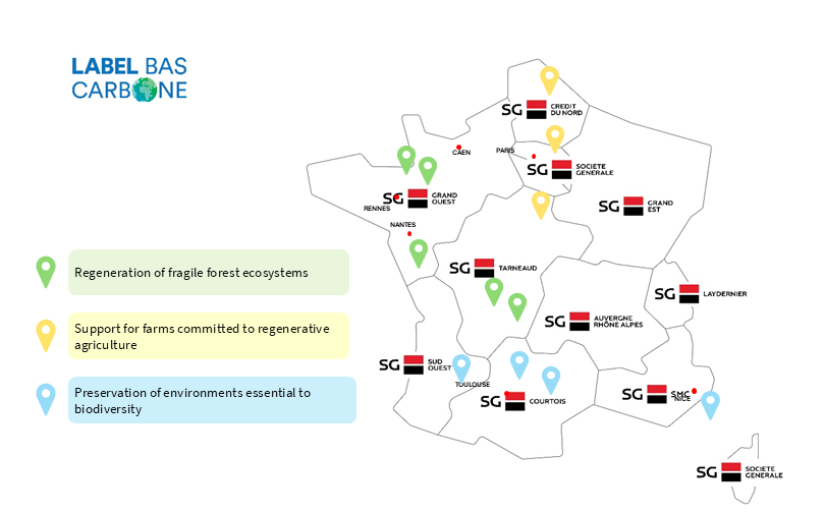
* out of 13 projects, 2 are currently undergoing certification (application submitted) and 11 have already been certified