From Minitel to the mobile app: the history of remote banking
In 1984, checking an account without going to a branch still seemed like science fiction. Today, it takes only a few seconds to access accounts, make a transfer or schedule an appointment with an advisor from a smartphone. A look back at forty years of remote banking evolution, which began well before the arrival of the Internet.
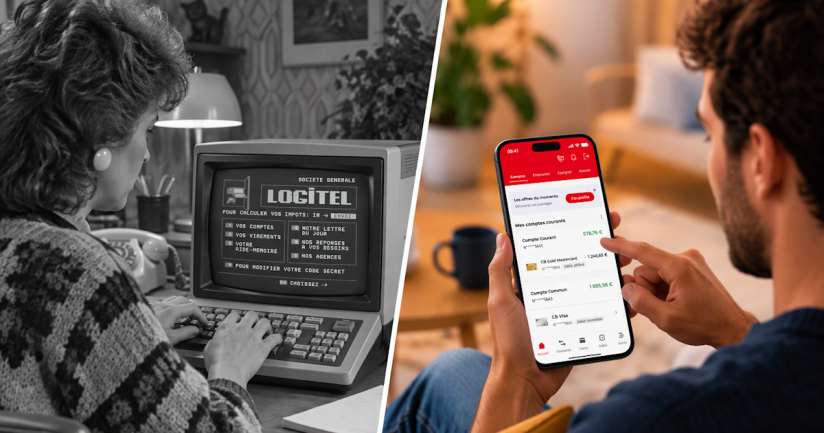
Logitel brings banking into the home
“Your bank at home.”
This promise already appeared in Societe Generale brochures in the mid-1980s. Long before the Internet and mobile apps, remote banking already existed under one name: Logitel.
Launched on a trial basis in 1984, then rolled out on a larger scale the following year, this service, accessible via Minitel, allowed clients to check their accounts, track their transactions, make transfers and obtain information on savings and credit from home.
At the time, the idea was bold. To access this information, clients still had to go to a branch or wait for their paper statement. With Logitel, the banking relationship crossed the threshold into the home.
The archives already reflect an ambition that is familiar to us today: giving clients greater autonomy and making it easier for them to access their bank.
Remote banking services as early as the 1980s
Although Minitel may now seem far removed from the way we use banking services today, Logitel already offered many features that have since become commonplace: checking accounts and recent transactions, making a transfer, accessing financial information or requesting an appointment.
By the end of the 1980s, the service had more than 100,000 subscribers. This success revealed a need that would span the decades: easier access to financial information and the ability to interact with a bank without necessarily having to travel.
The technology has changed. The need, much less so.
From Vocalia to Logitel Net, then to the smartphone
Over the years, the number of channels increased. In the early 1990s, Vocalia made it possible to check accounts by telephone. The Internet marked a new stage with the launch of Logitel Net at the end of the decade. A few years later, the smartphone in turn changed the way people used banking services: banking became accessible almost anywhere, at any time.
This evolution was not limited to technology. It also tells the story of how our relationship with money has evolved: what once required a trip, a phone call or waiting for a statement became accessible in just a few moments.
More immediate access to financial information
Everyone can now check their accounts and transactions almost instantly. This accessibility provides greater visibility and autonomy, thanks to clear, contextualized information that is directly useful for making decisions with confidence.
From the Minitel of 1984 to today’s mobile apps, successive innovations have made banking information increasingly immediate and accessible. Logitel first made it possible to check accounts from home, before the telephone, the Internet and the smartphone extended this evolution.
Artificial intelligence, a new chapter in this evolution
Artificial intelligence is now opening a new chapter in this story. Having enabled access to information, technologies could increasingly help people understand it, put it into context and use it to inform their decisions.
The tools change, but the common thread has remained the same since the early days of Logitel : putting innovation at the service of autonomy, education and trust.
Did you know?
On 23 November 1988, Societe Generale celebrated its 100,000th Logitel subscriber. Just a few years after its launch, banking from home had already become a reality
Further reading

29 boulevard Haussmann, a forward-looking address

Innovation and Architecture