Strategy
The Group’s CSR strategy is structured around four main priorities: supporting clients in their transition pathways, fostering local development, promoting responsible employment practices, and embedding a culture of responsibility across all activities.
These priorities apply across all the Group’s businesses, particularly its financing and investment activities, which contribute to a range of economic dynamics, including in sectors undergoing transition.
The strategy is supported by a governance framework led at the highest level by the Board of Directors. The Board is assisted by an independent censor whose role is to support its oversight of CSR matters, including the energy transition.
Ambitions supporting the CSR strategy
To support its CSR strategy, the Group has set several ambitions, including:
- progressively aligning its financing portfolios with pathways compatible with the objectives of the Paris Agreement, while supporting the transformation of key sectors, particularly energy-related industries (learn more on the “Decarbonization of activities” page);
- contributing EUR 500 billion to sustainable finance between 2024 and 2030 (see below);
- mobilizing EUR 1.5 billion in debt and equity, in order to further support the emerging players in the climate transition, and also the emerging leaders in climate change adaptation and nature-based solutions (learn more on the “Supporting clients” page);
- developing partnerships with institutions such as the International Finance Corporation (IFC), a member of the World Bank Group, and the European Investment Bank (EIB), while participating in international initiatives that support economic and environmental transition efforts (learn more on the “Supporting clients” page);
- reducing operational carbon emissions by 50% between 2019 and 2030 (learn more on the “Decarbonization of activities” page);
- for insurance activities, reducing the carbon footprint of investment portfolios and increasing the share of climate transition-related assets by 2030;
- reducing Ayvens' emissions, notably through the electrification of its vehicle fleet.
The Group is also progressively implementing measures to integrate biodiversity preservation considerations into its decisions and offerings, notably through sector policies and financial solutions. These initiatives aim to contribute to the preservation of natural resources within the scope of the Group’s role as a banking institution and in alignment with its activities (learn more on the “Nature” page).
On the social front, the Group has set targets to advance gender equality in the workplace and diversity (learn more on the “Responsible employer” page), including:
- reducing pay gaps between women and men;
- achieving a target of at least 35% women among senior leaders (Top 250, Group Leaders Circle) at Group level and 40% in France by 2029.
In addition, the Group’s philanthropic initiatives, led by its Foundation, support projects in the fields of education, culture and the environment (learn more on the “Philanthropy” page).
These commitments complement, rather than replace, the impacts generated through the Group’s economic activities.
An independent Scientific Advisory Council has been in place since June 2025 to provide the General Management with science-based recommendations on key emerging trends that may influence the Group’s businesses and activities in the future. Chaired by Subra Suresh, the Board brings together eight members with complementary expertise spanning technology, artificial intelligence, climate and nature, international and urban economics, social behavior, human rights and international relations.
Contributing to sustainable finance
The Group has set an ambition to reach approximately EUR 500 billion in cumulative sustainable finance contribution between 2024 and 2030, with around 80% allocated to environmental themes.
This target is composed of:
- approximately EUR 400 billion in financing activities, including advisory activities;
- approximately EUR 100 billion in sustainable bonds, for which only the portion attributable to Societe Generale is counted.
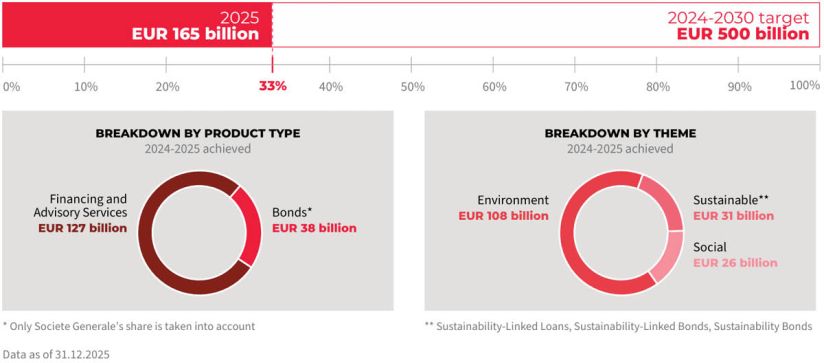
This contribution aims to direct part of financial flows toward activities supporting the decarbonization of the most carbon-intensive sectors, in line with the timeframe used by the Bank to define alignment targets for its lending portfolios.
The concept of sustainable finance is based on an internal Sustainable Finance Taxonomy, built on market standards and incorporating, where relevant, the European taxonomy. It is regularly updated to reflect regulatory, technological and market developments. The associated criteria, scope and methodologies are detailed in the Group’s publications, including the CSRD report (for more information, see the Universal Registration Document, page 271).
Financed activities notably include projects related to:
- energy transition infrastructure, low-carbon mobility and industrial solutions contributing to emissions reduction (learn more on the “Supporting clients” page);
- local economic development, sustainable and affordable real estate, and the development of essential infrastructure (learn more on the “Local development” page).
These activities form part of a diversified overall portfolio that also includes sectors at different stages of transition, which the Group supports in their evolution.
The Group operates across all its geographies, including Europe, the Americas and Asia, and serves all client segments, including corporates, financial institutions and individual customers.
25 years of environmental initiatives and financing
UNEP-FI
Participation in the United Nations Environment Program Finance initiative (UNEP FI)

Equator Principles
Project finance
COP 21
Coal sector policy, alignment with IEA 2°C scenario
Science-based targets
Setting emissions reduction targets
Katowice Commitment
5-bank pledge to align lending portfolio with Paris Agreement
Principles for responsible banking, collective commitment on climate action
Founding signatory and core member defining the principles

Poseidon Principles, Getting to Zero Coalition
Decarbonising the shipping industry: founding signatory
Sustainable IT Charter
Limiting environmental impact of technology and promoting digital inclusion
Hydrogen Council
Supporting the development of hydrogen for energy transition

Net-Zero Banking alliance (UNEP-FI)
One of the founding members
Sustainable Steel Principles
One of the founding members
Participation in working groups: Aluminum Climate-Aligned Finance & Aviation Climate-Aligned Finance

Act4nature
18 biodiversity commitments
Recognized commitment
The Group’s performance in these areas is assessed by external organizations, including ESG rating agencies, sustainability indices and rankings. The related results are presented below.

NB: ratings represent those allocated at annual reviews or in the event of significant methodology change of the agency.
World’s Best Bank for Sustainable Finance en 2026 & World’s Best Bank for Infrastructure & Project Finance 2025 for the 4th consecutive year by Global Finance

Best Investment Bank for Sustainable Financing for the 5th consecutive year by Global Finance
Further insights
Further reading

Supporting clients in the transition

Sector policies